
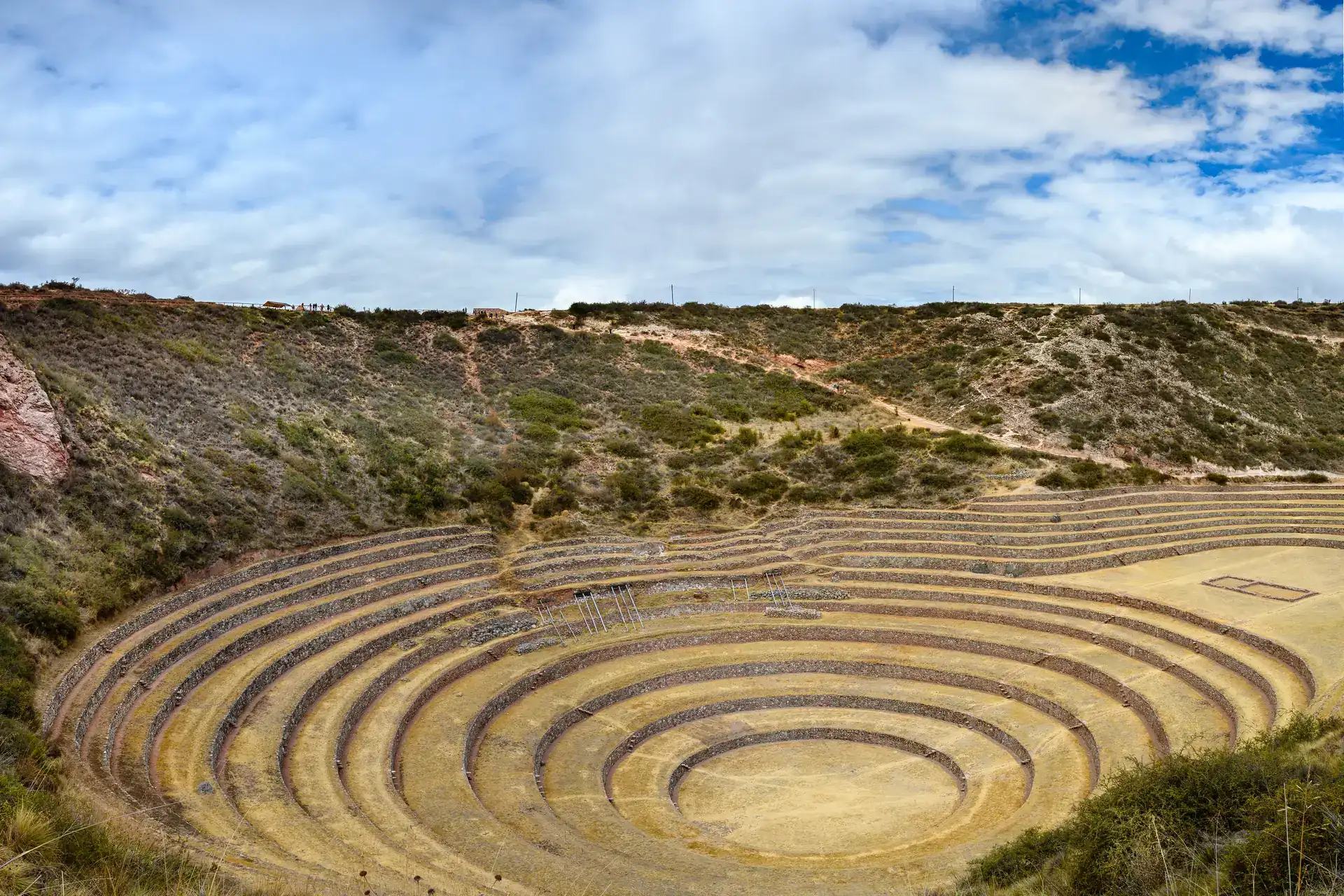
Moray and the Maras salt mines are two of the most photogenic sites near Cusco and are usually visited together, being a few kilometres apart on the plateau above the Sacred Valley. Moray is an enigmatic Inca complex of circular terraces; Maras is an amphitheatre of thousands of white and ochre salt pools clinging to the hillside. Together they take half a day and pair nicely with Chinchero or a stay in the Sacred Valley.
Start here: Cusco tips · things to do in Cusco
Moray: the circular terraces
Moray sits at about 3,500 m and consists of several natural depressions where the Incas built concentric terraces like an amphitheatre. The largest is about 30 m deep. The most widespread theory is that it was an agricultural research centre: there are notable temperature differences between the upper levels and the bottom, which may have allowed crops to be studied and adapted to different microclimates. Other researchers also suggest a ceremonial use.
To protect the site, walking down into the terraces isn't currently allowed; you follow a perimeter path with viewpoints.
- Machu Picchu history: who built it, why, and how the world found out
- Sacred Valley of the Incas: what to see and how to visit
Popular activities on GetYourGuide
The Maras salt mines
The salt mines are thousands of small stepped pools on a mountainside at about 3,300 m. A very salty spring emerges at the top and is channelled between the pools; as the sun evaporates the water, salt remains and families harvest it by hand. They've been worked since before the Incas and are now run by families of the Maras community, organised as a cooperative.
The view from the upper viewpoint is spectacular, especially in afternoon light. Shops at the entrance sell pink salt, herb salts and other products — a good souvenir that supports the community.
Maras salt
Maras salt is also sold in Cusco, but buying it at the salt mines benefits the producing families directly.
Tickets
- Moray: included in the Cusco Tourist Ticket, both the general one and the partial Sacred Valley circuit (with Pisac, Ollantaytambo and Chinchero). Individual tickets aren't sold.
- Maras salt mines: separate entrance charged by the community, paid in cash at the gate.
Prices change; check official information and carry cash in soles.
Getting there
- Half-day tour from Cusco: the easiest option, usually leaving in the morning or at midday, sometimes stopping in Chinchero. Check whether entrances are included.
- Taxi or private transport: from Cusco (about 1.5 hours) or Urubamba (about 30–40 minutes). Go at your own pace and pick the best light.
- Public transport: colectivo from Cusco towards Urubamba to the Maras turn-off, then a local taxi to Moray and the salt mines.
- By ATV or bike: adventure tours across the plateau.
- ATV tour to Maras and Moray: what the quad-bike trip from Cusco is like
- Chinchero: weaving, Inca ruins and market between Cusco and the Sacred Valley
- Getting around Cusco: taxis, ride apps, city buses and colectivos
Walking down from the salt mines to the valley
A highly recommended option is to finish by walking down from the salt mines to the valley floor near the community of Pichingoto, by the Urubamba River. It's roughly a 1-hour trail, mostly downhill, with changing views of the pools. At the bottom, cross the bridge and catch transport to Urubamba or Cusco. Wear shoes with good grip: the path has loose stones and narrow sections.
Best time and season
- The salt mines look best in the afternoon, with sun on the pools; Moray is pleasant in the morning, with fewer people.
- In the dry season (roughly May to October) the salt mines are in full production and look whiter.
- In the rainy season (roughly December to March) rain fills the pools and production stops; the landscape changes, more ochre with reflections.
Recommended combos
- Chinchero + Moray + Maras: the classic half or full day.
- Moray + Maras + Ollantaytambo: if you're sleeping in the Sacred Valley or catching the Machu Picchu train.
- Full Sacred Valley: some full-day tours include Pisac, Ollantaytambo, Moray and Maras, though with little time at each.
- Chinchero: weaving, Inca ruins and market between Cusco and the Sacred Valley
- Ollantaytambo: ruins, a living Inca town, the Machu Picchu train and tips
- Pisac: Inca ruins, craft market and how to visit from Cusco
Tips
- Sunscreen and a hat: the plateau is very exposed.
- Don't walk on the edges of the salt pools except on permitted paths; they're the families' livelihood.
- Bring water and snacks; there are few services beyond the entrances.
- If you're worried about altitude, these sites are slightly below or level with Cusco.
Frequently asked questions
- Are Moray and Maras on the Tourist Ticket?
- Moray is. The Maras salt mines have a separate entrance charged by the community.
- How much time do I need?
- Half a day for both from Cusco, or about 3 hours from Urubamba.
- Can I walk down into the Moray terraces?
- Not currently; you view them from a perimeter path with viewpoints.
- Can I walk to the salt mines?
- Yes, from the Urubamba valley (Pichingoto) there's a trail of about an hour uphill, or you can walk down from the salt mines.
Book this plan
- Maras and MorayCompareSee dates →
- ATV ride to Maras and MorayCompareSee dates →
- Sacred Valley tourCompareSee dates →
Notice: This guide shares advice and recommendations based on research and local experience. Prices, opening hours and rules may change: always check with official sources and operators. Cusco Tips is not responsible for third-party services, bookings or decisions made using these guides; some links are affiliate links (see our affiliate policy).
Related guides
Things to do in Cusco: 30 essentials in the city and beyond
Things to do in Cusco: the city's essentials, Machu Picchu, the Sacred Valley, day trips, treks, food, markets and festivals, with 1- to 3-day plans.
Read guide →
ATV tour to Maras and Moray: what the quad-bike trip from Cusco is like
Guide to the ATV tour to Maras and Moray: route, duration, licence questions, entrance fees, safety, best season and alternatives like biking or the classic tour.
Read guide →
Chinchero: weaving, Inca ruins and market between Cusco and the Sacred Valley
Chinchero guide: weaving centres and natural dyes, the Inca site and colonial church, the Sunday market, the Tourist Ticket, getting there from Cusco and how to combine it.
Read guide →
Sacred Valley of the Incas: what to see and how to visit
Sacred Valley guide: Pisac, Chinchero, Moray, the Maras salt pans and Ollantaytambo, tickets, how to visit (tour, independently or with a driver) and a 2-day plan.
Read guide →
Urubamba: the central base of the Sacred Valley (things to do, getting there and where to stay)
Urubamba guide: why it's the best base for exploring the Sacred Valley, things to do in town and nearby, getting there from Cusco and the airport, and what kind of lodging there is.
Read guide →