
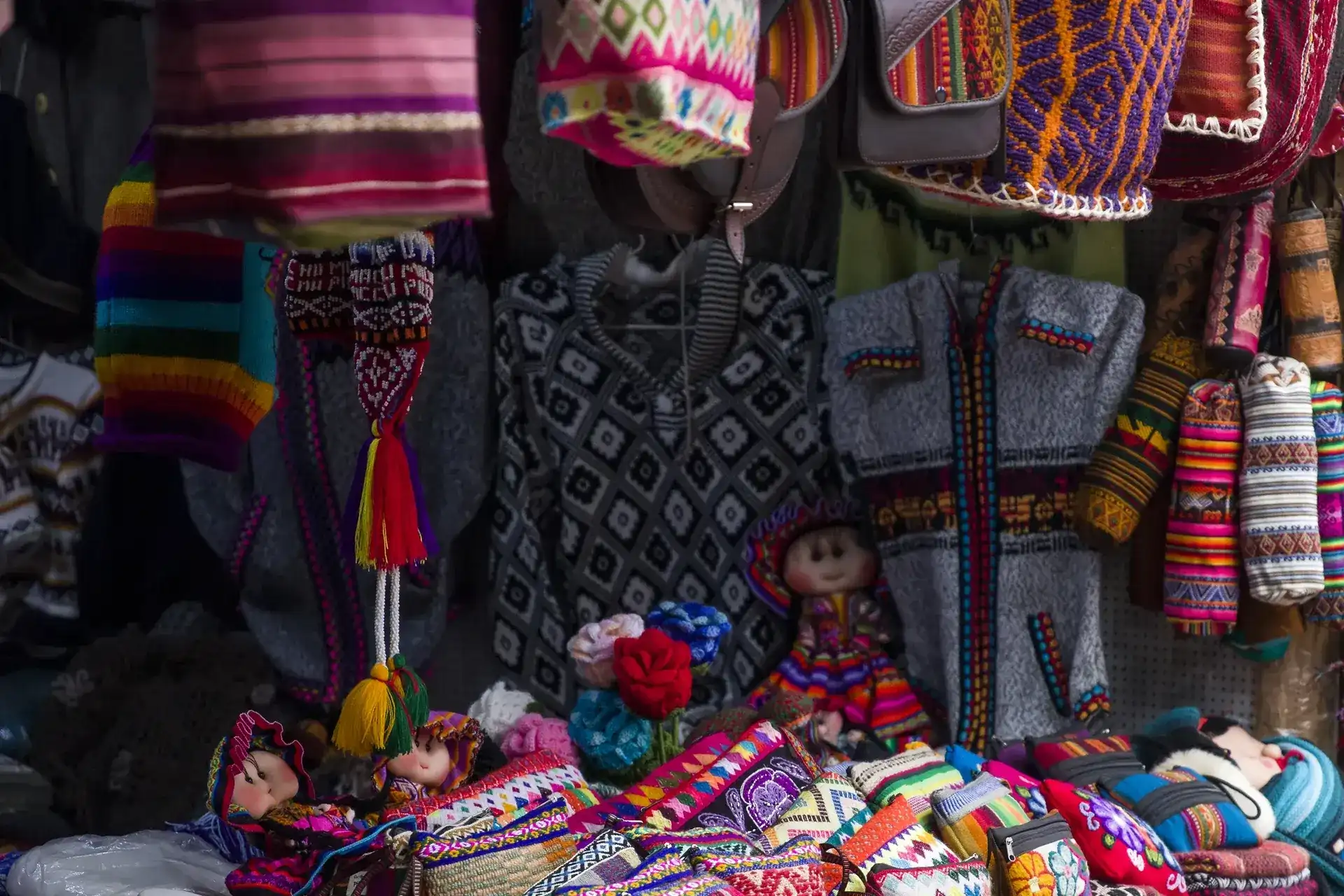
Chinchero is an Andean town on a plateau at about 3,760 m, between Cusco and the Sacred Valley. Many people only pass through on a quick tour stop, but it deserves more: here you'll find one of the liveliest textile traditions in the Andes, an Inca site with elegant terraces, a colonial church with a painted interior and a market where barter is still practised. Its views of the Urubamba range are among the best in the area.
Start here: Cusco tips · things to do in Cusco
The weaving centres
Chinchero is famous for its weavers. In several centres and cooperatives, women in the community's traditional dress demonstrate the whole process:
- Washing alpaca or sheep wool with roots that make natural suds.
- Spinning with the pushka, the traditional drop spindle.
- Making natural dyes from plants, minerals and cochineal, a cactus insect that gives intense reds, pinks and purples.
- Weaving on a backstrap loom, with designs that each have names and meanings.
The demonstration is usually free and ends in a sales room. There's no obligation to buy, but if you do you're directly supporting families. A handwoven piece takes weeks of work, which explains its price compared with factory pieces.
Spotting handmade
Handwoven textiles have small irregularities, less uniform colours and a reverse side showing the design threads. Ask which dyes were used and who wove it.
- Buying alpaca in Cusco: how to spot the real thing, prices and where to look
- Andean textiles in Cusco: weaving workshops, weaving communities and buying well
- What to buy in Cusco: authentic souvenirs and what to avoid
Popular activities on GetYourGuide
The archaeological site
Chinchero was a royal estate of the Inca Túpac Yupanqui, son of Pachacútec. Broad stone farming terraces step down the hillside, along with walls with trapezoidal niches, palace remains and carved rocks with steps and seats. Walking the terraces at sunset with snow peaks behind is one of the visit's highlights.
- Machu Picchu history: who built it, why, and how the world found out
- Pisac: Inca ruins, craft market and how to visit from Cusco
The colonial church
In the early 17th century the church of Our Lady of the Nativity (or Montserrat) was built on top of Inca walls. The exterior is simple, but the interior is covered in murals with floral and geometric motifs and holds Cusco School paintings. Photography isn't allowed inside.
The Sunday market
On Sunday mornings a market fills the town square. One part is for visitors, with crafts; the more interesting part is where families from nearby communities trade and sell potatoes, corn, vegetables and other produce, sometimes still by barter. It's a good chance to see local life; go early and buy some fruit or bread to take part.
- Local markets in Cusco: Wanchaq, Huancaro, Vinocanchón and beyond San Pedro
- Pisac: Inca ruins, craft market and how to visit from Cusco
Entrance: the Tourist Ticket
The Chinchero archaeological site (with the church in the same compound) is included in the Cusco Tourist Ticket — both the general ticket and the partial Sacred Valley circuit ticket, which usually also covers Pisac, Ollantaytambo and Moray. Individual tickets aren't sold. Fees change; check official information.
Getting there from Cusco
- By colectivo or bus: they leave Cusco for Urubamba via Chinchero; the ride takes roughly 45 minutes to 1 hour. Ask to get off in town.
- By taxi or private transport: convenient if you want to combine it with Moray, Maras and Urubamba on the same day.
- On a Sacred Valley tour: many tours include Chinchero, often at the end of the day. Check how much time you get there.
- Getting around Cusco: taxis, ride apps, city buses and colectivos
- Sacred Valley of the Incas: what to see and how to visit
How to combine it
- Chinchero + Moray + Maras: a classic half- or full-day combo, as they're close together.
- Chinchero on the way to the valley: if you're staying in Urubamba or Ollantaytambo, stop here en route.
- Chinchero on a Sunday: catch the market and the community mass.
- Moray and the Maras salt mines: how to visit from Cusco or the Sacred Valley
- Urubamba: the central base of the Sacred Valley (things to do, getting there and where to stay)
- Ollantaytambo: ruins, a living Inca town, the Machu Picchu train and tips
The new airport
A new international airport, meant to replace Cusco's current one, is being built near Chinchero. Its opening has been delayed several times; check up-to-date news if you're planning around it. For now, flights still arrive at the airport in Cusco city.
Altitude
Chinchero is a little higher than Cusco, so it isn't the best place to sleep for your first nights if you're worried about altitude. As a day visit it's usually fine once you've had a day or two in the region.
Frequently asked questions
- What is there to see in Chinchero?
- Weaving centres with natural-dye demonstrations, the Inca site and terraces, the painted colonial church and, on Sundays, the market.
- Is Chinchero included in the Tourist Ticket?
- Yes, in the general ticket and the partial Sacred Valley circuit ticket.
- How long does it take to get there from Cusco?
- Roughly 45 minutes to 1 hour by car or colectivo.
- When is the Chinchero market?
- On Sunday mornings, in the town square.
Book this plan
- Sacred Valley tourCompareSee dates →
- Maras and MorayCompareSee dates →
Notice: This guide shares advice and recommendations based on research and local experience. Prices, opening hours and rules may change: always check with official sources and operators. Cusco Tips is not responsible for third-party services, bookings or decisions made using these guides; some links are affiliate links (see our affiliate policy).
Related guides
Things to do in Cusco: 30 essentials in the city and beyond
Things to do in Cusco: the city's essentials, Machu Picchu, the Sacred Valley, day trips, treks, food, markets and festivals, with 1- to 3-day plans.
Read guide →
Sacred Valley of the Incas: what to see and how to visit
Sacred Valley guide: Pisac, Chinchero, Moray, the Maras salt pans and Ollantaytambo, tickets, how to visit (tour, independently or with a driver) and a 2-day plan.
Read guide →
Buying alpaca in Cusco: how to spot the real thing, prices and where to look
Differences between baby alpaca, alpaca, llama, vicuña and synthetic blends; how to recognise genuine garments by feel and label, price ranges and where to buy.
Read guide →
Cusco Tourist Ticket (Boleto Turístico): what's included and is it worth it
Guide to the Cusco Tourist Ticket (COSITUC): full and partial tickets, sites in each circuit, what it does NOT include, where to buy it and how to use it.
Read guide →
Urubamba: the central base of the Sacred Valley (things to do, getting there and where to stay)
Urubamba guide: why it's the best base for exploring the Sacred Valley, things to do in town and nearby, getting there from Cusco and the airport, and what kind of lodging there is.
Read guide →