
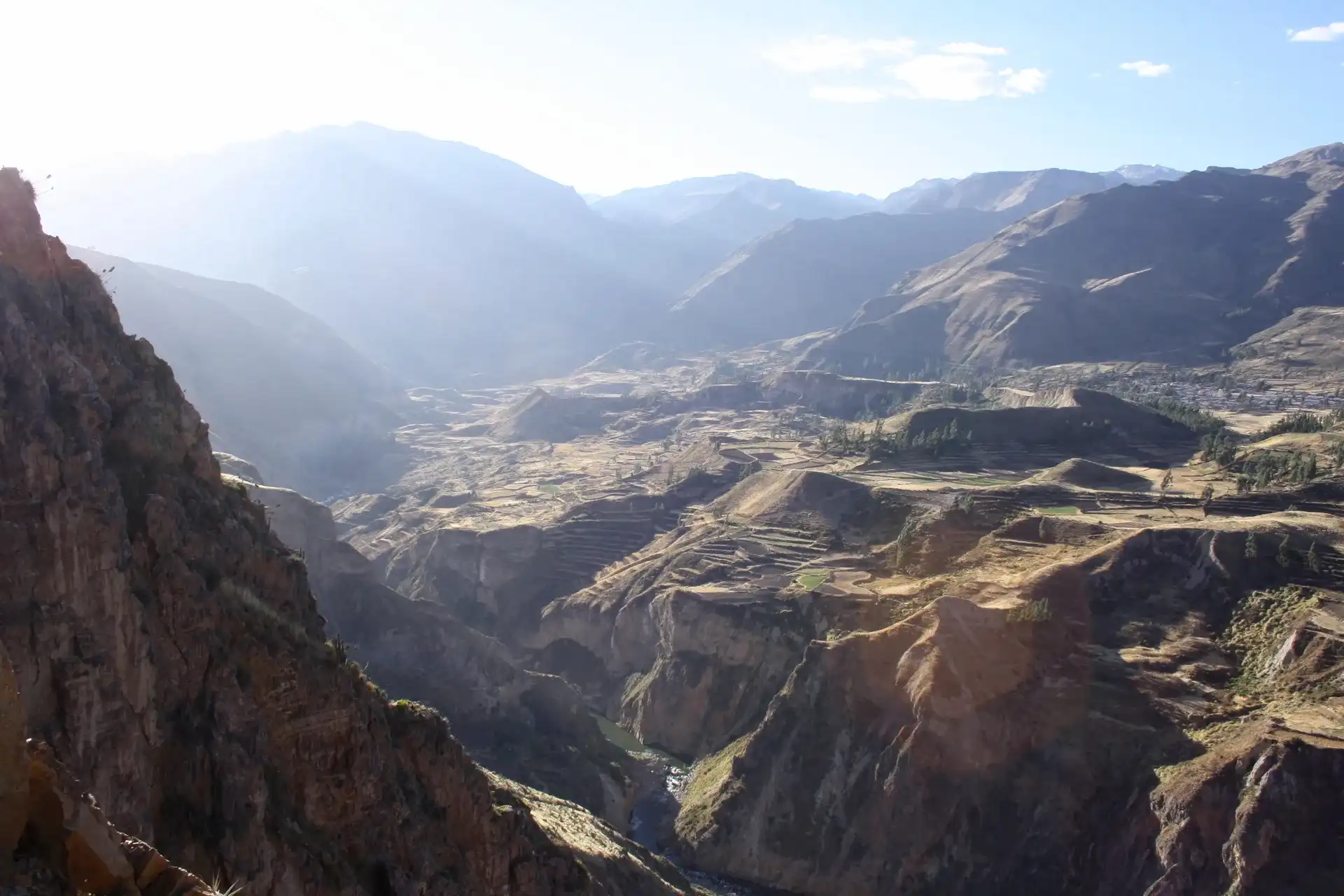
Colca Canyon, in the Arequipa region, is one of the best places in Peru to see wild Andean condors, along with farming terraces, colonial villages and volcanic scenery. Many travellers look for it from Cusco, but it is not close: you cross the high Altiplano for most of a day. This guide explains the three realistic ways to get there, the ticket you need on arrival and how to fit it into a southern Peru route.
Start here: Cusco tips · things to do in Cusco
First things first: it is not a day trip
Chivay, the gateway to the Colca valley, is about 9 hours by road from Cusco on the direct tourist bus. Cruz del Cóndor, the most famous viewpoint, lies further on, across the valley. So there is no point trying to go and come back in a day: you need at least two nights in the area, or to link Colca with Arequipa or Puno as part of a longer route.
Altitude
The road crosses the Altiplano and its highest point is the Patapampa viewpoint, at 4,910 m according to the bus company. Travel well acclimatised to Cusco, drink water and bring warm layers.
Popular activities on GetYourGuide
Option 1: the direct Cusco–Chivay tourist bus
The most direct way is the shared tourist bus run by 4M Express. According to its website (checked November 2026):
- Cusco to Chivay: Tuesday, Thursday and Saturday, March to December. Boarding at 06:10 on Plaza Regocijo, departure 06:20; arrival at Chivay's Plaza de Armas between 15:00 and 16:00, about 9 hours.
- Chivay to Cusco: Monday, Wednesday and Friday, March to December, leaving at 06:20 and arriving in Cusco between 17:00 and 18:00, about 10 hours.
- Published fare: US$82 each way, with an English and Spanish-speaking guide on board and a snack.
- Stops en route: Langui lagoon, Patahuasi, the Salinas y Aguada Blanca National Reserve (with vicuñas, alpacas and llamas) and Patapampa.
The company asks you to get in touch first to confirm availability, and prices and times may change: check its official website before planning.
Off season
According to its website, the direct service runs from March to December. If you travel in January or February, the route via Arequipa is the safer bet.
Option 2: via Arequipa
This is the most common combination because it adds a beautiful city to your trip. According to the Peruvian government's official guide, Cusco and Arequipa are about 515 km apart, around 10 hours by bus or one hour by plane. Plenty of 2- and 3-day Colca tours leave from Arequipa, including transport, a night in Chivay and Cruz del Cóndor; there are also regular buses to Chivay, about 3–4 hours away.
- Cusco to Arequipa by overnight bus or flight.
- One or two days in Arequipa to rest.
- A 2-day Colca tour with a night in Chivay, or 3 days if you want to hike to the canyon floor.
- Back to Arequipa or on to Puno.
Option 3: via Puno and Lake Titicaca
If your route includes Titicaca, you can go from Cusco to Puno and on to Colca from there. The same company publishes a daily Puno–Chivay tourist service of about 6 hours for US$54, stopping at Lagunillas, Patahuasi and Patapampa. Afterwards you can head down from Chivay to Arequipa and close the southern loop.
The Colca tourist ticket
To tour the valley and visit Cruz del Cóndor you need the tourist ticket managed by Autocolca, the Colca's autonomous authority. According to its official website, it costs S/70 for foreigners, S/40 for Latin Americans and S/20 for Peruvians. It covers access to the tourist circuit, but not transport, guiding or some attractions such as the La Calera hot springs. It is sold online and at the checkpoint at the entrance to Chivay. Tours almost never include it: carry cash in soles or buy it in advance on the official site.
What to see in Colca
- Cruz del Cóndor: the viewpoint over the canyon where condors are often seen riding the thermals. Tours arrive early in the morning.
- Valley villages: Yanque, Achoma, Maca and Cabanaconde, with colonial churches and squares where dancers and vendors often gather.
- Farming terraces: andenes covering the valley slopes, still under cultivation.
- Hot springs: several near Chivay, with a separate entry fee.
- Trekking to the canyon floor: 2–3 day routes with steep climbs leave from Cabanaconde.
Where to stay
Chivay is the most practical base: it has the widest choice of hotels and is where the buses arrive. Yanque and other valley villages are quieter, and Cabanaconde is the best base for hiking down into the canyon.
Travel tips
- Bring layers: the Altiplano is cold in the morning and the midday sun is strong.
- Carry cash in soles for the ticket, hot springs and village purchases.
- Buses leave very early; pack your bag the night before.
- If you hike to the canyon floor, check that your insurance covers trekking.
Before you go

eSIM for Peru
Land connected: install an Airalo data eSIM before you travel and switch it on when you land. Check first that your phone supports eSIM and is unlocked.
Get online in Peru →Frequently asked questions
- Can you visit Colca Canyon as a day trip from Cusco?
- Not realistically: the direct bus to Chivay alone takes about 9 hours. Plan at least two nights in the area or combine it with Arequipa.
- Is there a direct bus from Cusco to Chivay?
- Yes, 4M Express publishes a shared Cusco–Chivay tourist bus on Tuesdays, Thursdays and Saturdays from March to December; confirm times and fares before you travel.
- How much is the Colca tourist ticket?
- According to Autocolca, S/70 for foreigners, S/40 for Latin Americans and S/20 for Peruvians.
- Is it better to visit Colca from Arequipa?
- For most people, yes: there are more tours and buses, the trip is shorter and Arequipa makes a good rest stop.
Official sources
Book this plan
- Cusco city tourCompareSee dates →
- Sacred Valley tourCompareSee dates →
- Machu Picchu day trip from CuscoCompareSee dates →
Notice: This guide shares advice and recommendations based on research and local experience. Prices, opening hours and rules may change: always check with official sources and operators. Cusco Tips is not responsible for third-party services, bookings or decisions made using these guides; some links are affiliate links (see our affiliate policy).
Related guides

Cusco to Arequipa: overnight bus, flights, via Puno or by luxury train
How to get from Cusco to Arequipa: overnight bus (duration, classes, safety), direct or connecting flights, the route via Puno and Titicaca, the luxury train and altitude tips.
Read guide →
Cusco to Puno and Lake Titicaca: bus, tourist bus, train or plane
How to get from Cusco to Puno: direct bus (about 6–7 h), tourist bus with stops at Raqchi and La Raya, scenic train or flight to Juliaca. Altitude, tips and what to see on Titicaca.
Read guide →
Altitude sickness in Cusco: how to prevent it and what to do
Cusco sits at about 3,400 m. Altitude sickness symptoms, warning signs, how to acclimatize, coca tea, medication and when to do the highest day trips.
Read guide →
Birdwatching in Cusco: Huacarpay, Abra Málaga and Machu Picchu
A guide to birdwatching around Cusco: the Huacarpay wetland, polylepis woods at Abra Málaga, hummingbirds and cock-of-the-rock near Machu Picchu, season, gear and guides.
Read guide →
Cochahuasi Animal Sanctuary: rescued condors on the road to Pisac
Guide to Cochahuasi Animal Sanctuary at km 22 of the Cusco–Pisac road: which rescued animals you will see, the story of its condors, how to get there and how to visit responsibly.
Read guide →