
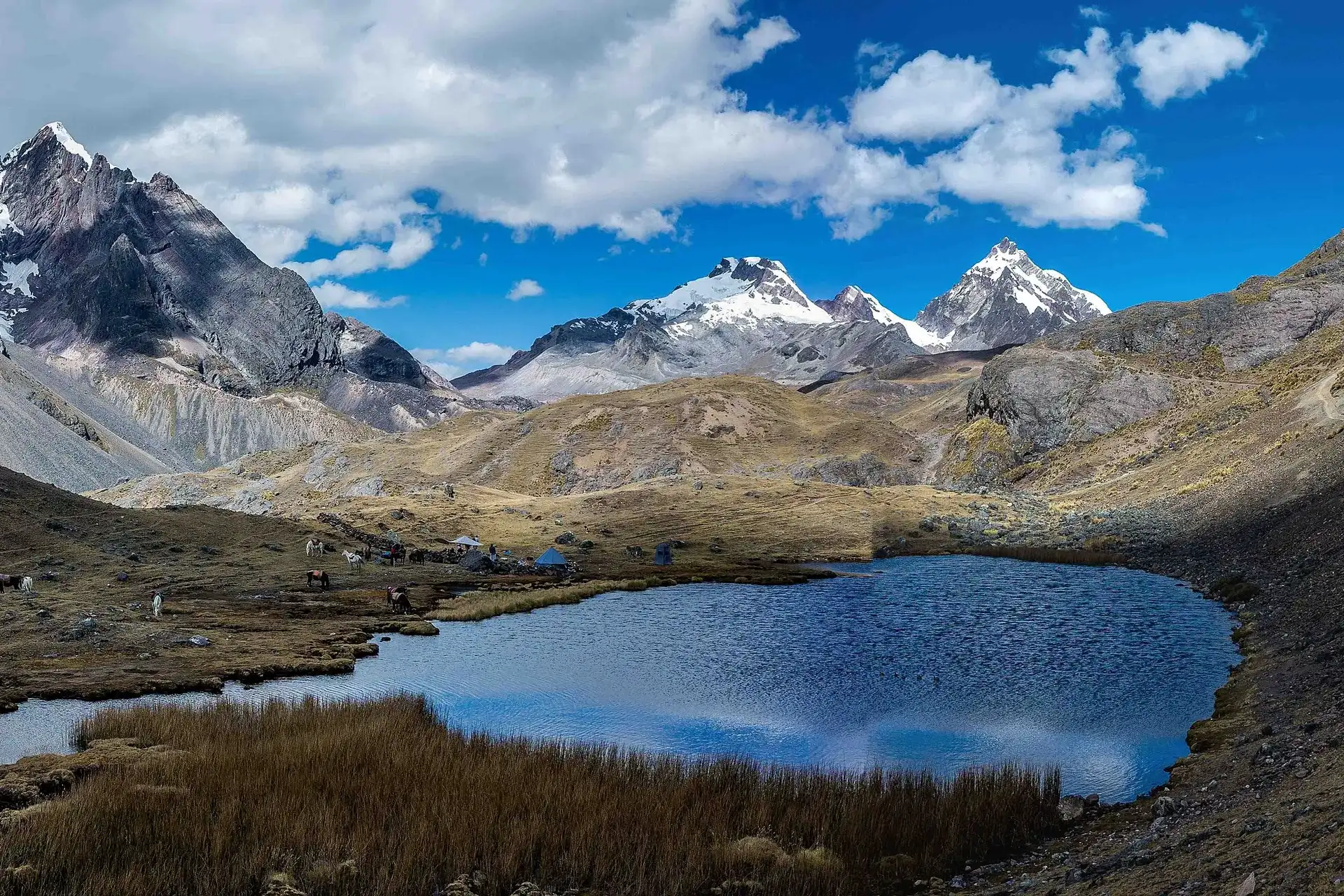
If you want a turquoise lake beneath a glacier and only have one free day in Cusco, you will soon face this question: Humantay Lake or the Ausangate Seven Lakes? Both are day trips from the city, both sit above 4,000 metres and both deliver stunning photos. Yet they feel very different: one is a short, steep climb to a single, very famous lake; the other is a longer, quieter loop past several lakes, finishing with a soak in hot springs. Here is a point-by-point comparison so you can pick the one that suits you.
Start here: Cusco tips · things to do in Cusco
Quick answer: which one?
- Choose Humantay if: you are short on time, want fewer hours on the road and are happy with one spectacular lake under a snow peak.
- Choose the Seven Lakes if: you are already well acclimatised, prefer longer walking on gentler slopes, want fewer people and like the idea of ending in hot springs.
- If this is your first high-altitude outing and you have only been in Cusco a few days, Humantay is usually the shorter test; the Seven Lakes keep you above 4,300 m for much longer.
Popular activities on GetYourGuide
Side-by-side comparison
Humantay Lake
- Trailhead: Soraypampa, about 3,900 m, near Mollepata.
- Highest point: the lake, about 4,200 m.
- Hike: 1–2 hours up a steep path and about 1 hour down.
- Drive: roughly 2.5–3.5 hours each way from Cusco.
- Feel: very busy, especially mid-morning in the dry season.
Ausangate Seven Lakes
- Trailhead: Pacchanta community, near Tinqui, about 4,300 m.
- Highest point: around 4,600–4,700 m.
- Hike: a loop of about 8–10 km and 3–4 hours on gentler gradients.
- Drive: roughly 3–4 hours each way from Cusco.
- Feel: quieter, with llamas, alpacas and herding families along the way.
The key difference
Humantay is lower but steeper; the Seven Lakes are higher and longer, with kinder climbs. Ask yourself whether steep slopes or sustained altitude tire you more.
Altitude and difficulty
At Humantay the effort comes in one block: a zigzag climb that does not let up for one or two hours. Many people take it slowly, pausing every few minutes, and make it fine. The Seven Lakes have no climb that steep, but you start at about 4,300 m and spend the whole morning between 4,300 and 4,700 m. For bodies that are not yet acclimatised, that sustained altitude can feel harder than Humantay's slope.
Whichever you choose, spend two or three days in Cusco or the Sacred Valley first, drink water and eat light the night before.
Altitude
If you get a severe headache, strong dizziness, vomiting or breathlessness at rest, tell your guide and go down. See a doctor beforehand if you have heart or lung conditions or are pregnant.
Scenery: one lake or seven
Humantay is a single turquoise lake set beneath Humantay peak, in the Salkantay area. The photo is iconic and the view from the shore makes the climb worthwhile. The Seven Lakes offer variety: the trail links lakes such as Pucacocha, Patacocha, Q'omercocha and Azulcocha, each a different colour, with Ausangate's glacier tongues close by. If you love landscape photography with shifting light and colour, the Seven Lakes give you more; if you want the famous shot, Humantay is the safe bet.
Crowds and atmosphere
Humantay is one of Cusco's best-selling day trips, so in the dry season you will share the trail and shoreline with many groups. The Seven Lakes see fewer visitors because they are further away, and the setting is more rural: alpaca and llama herding communities, stone houses and the silence of the high puna. If you want peace and quiet, the difference is obvious.
The hot springs bonus
At the end of the Seven Lakes loop, Pacchanta has community-run hot spring pools with views of the peak. After the cold, it is the perfect reward. Humantay has no hot springs on the route. If you go to the Seven Lakes, pack swimwear, a towel and sandals.
Timings and logistics
Both are mostly done as full-day tours:
- Pick-up in Cusco before dawn, usually between 3:30 and 5:00 am.
- A breakfast stop on the way.
- Back in Cusco in the late afternoon or early evening; Seven Lakes tours usually return later.
- Both charge a modest community access fee, separate from the tour if not included, not part of the Boleto Turístico and paid in cash. Fees change.
Going independently is possible but fiddly: for Humantay you need transport to Mollepata and then on to Soraypampa; for the Seven Lakes it makes sense to sleep in Tinqui or Pacchanta.
Horses on the trail
On both routes local families rent horses, paid in cash. At Humantay they can carry you up much of the climb, though the last stretch is usually on foot. Horses are also offered in Pacchanta for the Seven Lakes. Hiring one is a good idea if the altitude hits you, and the money stays in the community.
Best season for each
From May to September, the dry season, you get clear skies and the most vivid lake colours, but sub-zero dawns at both. From November to March expect more cloud, mud and possible snow; at the Seven Lakes cold and snow are felt more because they are higher. In the rainy season, Humantay is usually the easier one to complete.
- Cusco weather by month: temperatures, rain and what to expect
- Best time to visit Cusco and what to pack
What if I want to do both?
You can, but not on the same day: they lie in opposite directions from Cusco. A sensible order is Humantay first, as it is lower, then at least one rest day before the Seven Lakes. If you still want more, Rainbow Mountain or Palccoyo complete the classic trio of high-altitude landscapes.
- Rainbow Mountain or Humantay Lake? A comparison to choose your day trip
- Palccoyo: the alternative rainbow mountain, easier and quieter than Vinicunca
What to pack for either
- Warm jacket, hat, gloves and thermal layers.
- Hiking shoes with good grip and poles if you use them.
- High-factor sunscreen, sunglasses and SPF lip balm.
- About 2 litres of water and snacks.
- Cash in soles for fees, horses and toilets.
- Swimwear and a towel if you choose the Seven Lakes.
Frequently asked questions
- Which is harder, Humantay or the Seven Lakes?
- Humantay has a short but very steep climb; the Seven Lakes are longer and higher with gentle gradients. The sustained altitude of the Seven Lakes is tougher if you are not acclimatised.
- Which one is less crowded?
- The Seven Lakes, because they are further from Cusco and see fewer groups.
- Which one is closer to Cusco?
- Humantay: about 2.5–3.5 hours by road, versus 3–4 hours to Pacchanta.
- Can I do both in one day?
- No. They are in opposite directions; leave at least one day between them.
Official sources
Book this plan
- Rainbow Mountain (Vinicunca)CompareSee dates →
- Humantay LakeCompareSee dates →
- Sacred Valley tourCompareSee dates →
Notice: This guide shares advice and recommendations based on research and local experience. Prices, opening hours and rules may change: always check with official sources and operators. Cusco Tips is not responsible for third-party services, bookings or decisions made using these guides; some links are affiliate links (see our affiliate policy).
Related guides
Humantay Lake: how to get there, the hike and tips
Practical guide to Humantay Lake (~4,200 m): tours from Cusco, going independently via Mollepata and Soraypampa, the hike, altitude, best season and packing.
Read guide →
Ausangate Seven Lakes: a one-day hike from Cusco
Ausangate Seven Lakes guide: the loop from Pacchanta, altitude and difficulty, hot springs, getting there from Cusco, best season, what to pack and comparison with Humantay.
Read guide →
Rainbow Mountain or Humantay Lake? A comparison to choose your day trip
We compare Vinicunca and Humantay: altitude, difficulty, schedule, scenery, weather and approximate cost, to decide which to do with one day (or how to do both).
Read guide →
Altitude sickness in Cusco: how to prevent it and what to do
Cusco sits at about 3,400 m. Altitude sickness symptoms, warning signs, how to acclimatize, coca tea, medication and when to do the highest day trips.
Read guide →
Palccoyo: the alternative rainbow mountain, easier and quieter than Vinicunca
Palccoyo guide: the hike, altitude, getting there from Cusco, the stone forest, entrance, comparison with Vinicunca and tips to enjoy it without the crowds.
Read guide →