
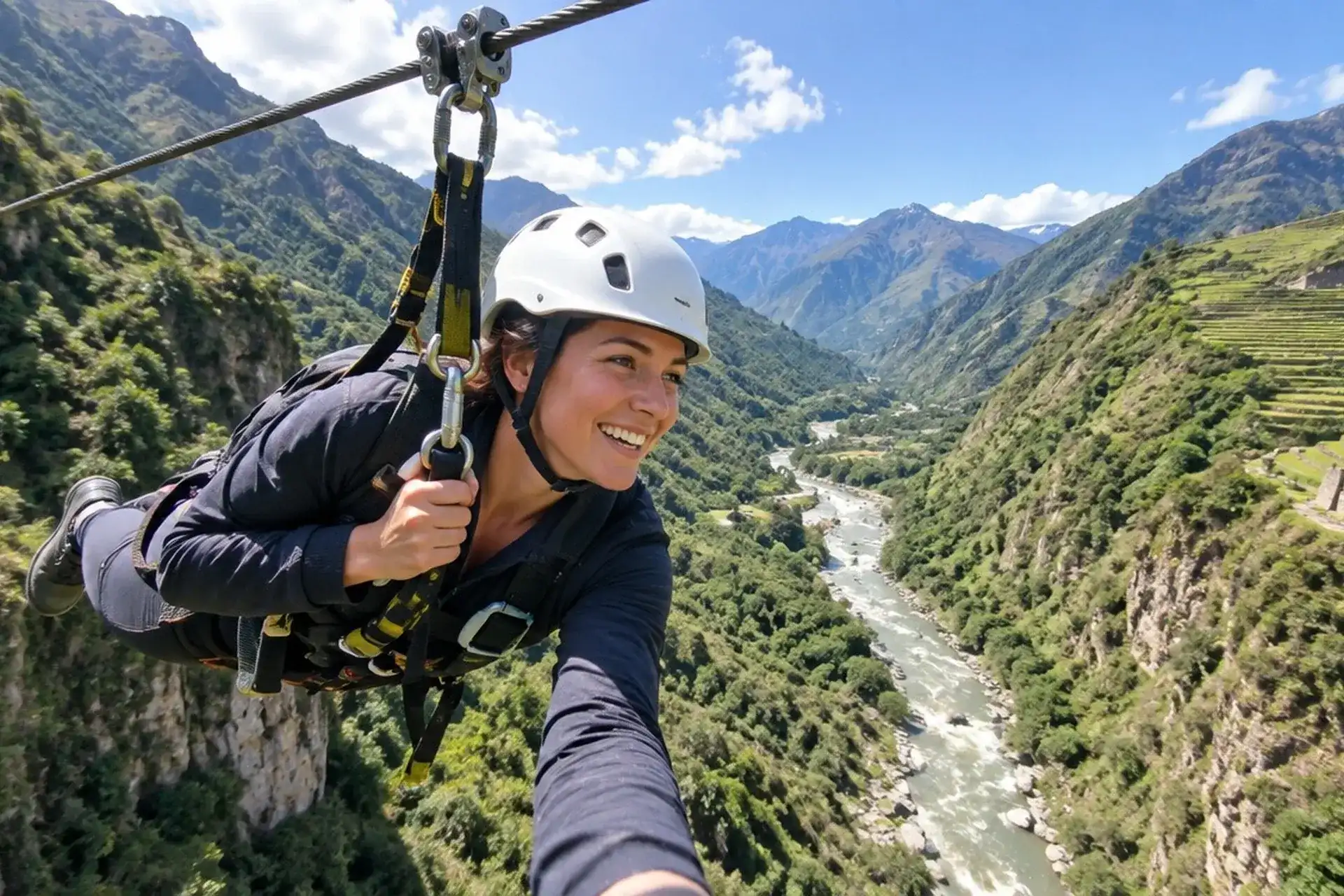
If you want a shot of adrenaline between archaeological sites, the Cusco region has two activities that have become hugely popular: via ferrata, an assisted climb up a vertical wall on metal rungs with a safety cable, and ziplines, cables you glide along in a harness above valleys and rivers. The best known are in the Sacred Valley and around Santa Teresa on the way to Machu Picchu.
Start here: Cusco tips · things to do in Cusco
The Sacred Valley via ferrata
On the rock walls around the Sacred Valley, between Urubamba and Ollantaytambo, via ferratas are equipped with steel rungs anchored into the rock and a continuous safety cable you're always clipped to with two carabiners.
- The climb usually gains about 300–400 m and takes roughly 2–3 hours.
- No climbing experience needed: guides teach the clipping technique before you start.
- Views of the valley and Urubamba River from the top are spectacular.
- The descent is by a series of ziplines, rappel or a trail, depending on the operator.
Vertigo
The sense of exposure is intense: you're hanging on a vertical wall. If you have strong vertigo, try the ziplines alone first.
- Sacred Valley of the Incas: what to see and how to visit
- Ollantaytambo: ruins, a living Inca town, the Machu Picchu train and tips
- Urubamba: the central base of the Sacred Valley (things to do, getting there and where to stay)
Popular activities on GetYourGuide
The ziplines
- Sacred Valley: circuits of several ziplines, sometimes combined with the via ferrata, with long cables over the valley.
- Santa Teresa: very popular on the Inca Jungle route and with travellers heading to Machu Picchu via Hidroeléctrica. Several cables cross the Vilcanota valley in high-jungle surroundings, with hanging bridges on some circuits.
- Ziplines suit almost everyone: no physical effort, just follow instructions.
- Inca Jungle Trek: biking, rafting, ziplining and hiking to Machu Picchu
- Machu Picchu via Hidroeléctrica and Santa Teresa: the budget route step by step
Who it's for
- Age: operators usually set a minimum age and sometimes minimum and maximum weights. Check before booking if travelling with children.
- Fitness: the via ferrata needs moderate arm and leg strength and some stamina; ziplines need almost none.
- Health: not advisable if you're pregnant or have heart or back problems or recent injuries.
Safety: choosing an operator
- Guides trained in vertical rescue and first aid.
- Harness, helmet, gloves and a double lanyard with carabiners in good condition.
- A safety talk and practice on a low section before starting.
- Small groups with a good guide-to-participant ratio.
- Accident insurance for the activity — check your travel insurance too.
Ask when the installation was last inspected and don't choose on price alone.
- How to choose a tour agency in Cusco: a checklist to get it right
- Is Cusco safe? Real risks and practical tips for a worry-free trip
How to combine it
- Via ferrata + ziplines + Sacred Valley: a full adventure day from Cusco, or half a day if you're staying in the valley.
- Santa Teresa ziplines + Machu Picchu: part of the Inca Jungle trek or the Hidroeléctrica route.
- Rafting + ziplines: some operators combine both on the same day.
- Rafting in Cusco: Urubamba sections, the Apurímac, seasons and safety
- Inca Jungle Trek: biking, rafting, ziplining and hiking to Machu Picchu
Best season
Both run year-round, but in the rainy season (roughly December to March) rock and cables can be wet and some departures are cancelled for storms. The dry season, May to October, is most pleasant.
What to bring
- Comfortable sportswear and closed shoes with good soles (no sandals).
- A light jacket: it's windy at the top of the wall.
- Sunscreen and water.
- Glasses on a strap if you need them.
- Zipped pockets or a small bum bag: no loose items that could fall.
Altitude
The Sacred Valley is lower than Cusco, which makes these activities easier. Still, wait at least a day to acclimatise before the via ferrata.
What a via ferrata day looks like
- Early pick-up in Cusco, or at your Sacred Valley accommodation, and transfer to the base of the wall.
- Gear-up: harness, helmet, gloves and double lanyard. Guides check everything is properly adjusted.
- Technique briefing: always one carabiner clipped to the safety cable; never unclip both at once.
- Climb the rungs, with stops on ledges to rest, drink water and take photos.
- At the top, time to enjoy the view and, depending on the circuit, start the descent by zipline or rappel.
- Lunch or a snack and return.
Allow half a day if you're staying in the valley and most of a day from Cusco.
Rough price
Price depends on whether you choose ziplines only, via ferrata only or both, whether transport from Cusco is included and whether there's a meal. Santa Teresa ziplines are usually cheaper and often booked as an Inca Jungle add-on. Compare inclusions and be wary of very cheap offers: gear and guide training are crucial in these activities.
Frequently asked questions
- Do I need experience for the via ferrata?
- No. Guides explain the technique and you're always clipped to a safety cable.
- Where are the most popular ziplines?
- In the Sacred Valley and in Santa Teresa, on the Inca Jungle route to Machu Picchu.
- Can children do it?
- It depends on the operator, who sets minimum age and weight. Check before booking.
- How long does the via ferrata take?
- Roughly 2–3 hours of climbing, plus the descent by zipline, rappel or trail.
Book this plan
- Sacred Valley ziplineCompareSee dates →
- Urubamba river raftingCompareSee dates →
Notice: This guide shares advice and recommendations based on research and local experience. Prices, opening hours and rules may change: always check with official sources and operators. Cusco Tips is not responsible for third-party services, bookings or decisions made using these guides; some links are affiliate links (see our affiliate policy).
Related guides
Things to do in Cusco: 30 essentials in the city and beyond
Things to do in Cusco: the city's essentials, Machu Picchu, the Sacred Valley, day trips, treks, food, markets and festivals, with 1- to 3-day plans.
Read guide →
Rafting in Cusco: Urubamba sections, the Apurímac, seasons and safety
Guide to rafting in Cusco: Urubamba River sections (Cusipata, Sacred Valley, Santa Teresa), Apurímac expeditions, difficulty grades, seasons, safety and choosing an operator.
Read guide →
Inca Jungle Trek: biking, rafting, ziplining and hiking to Machu Picchu
Inca Jungle guide: 3–4 day route with a bike descent from Abra Málaga, optional rafting and zipline, a hike to Santa Teresa, hot springs and arrival in Aguas Calientes.
Read guide →
ATV tour to Maras and Moray: what the quad-bike trip from Cusco is like
Guide to the ATV tour to Maras and Moray: route, duration, licence questions, entrance fees, safety, best season and alternatives like biking or the classic tour.
Read guide →
Sacred Valley of the Incas: what to see and how to visit
Sacred Valley guide: Pisac, Chinchero, Moray, the Maras salt pans and Ollantaytambo, tickets, how to visit (tour, independently or with a driver) and a 2-day plan.
Read guide →